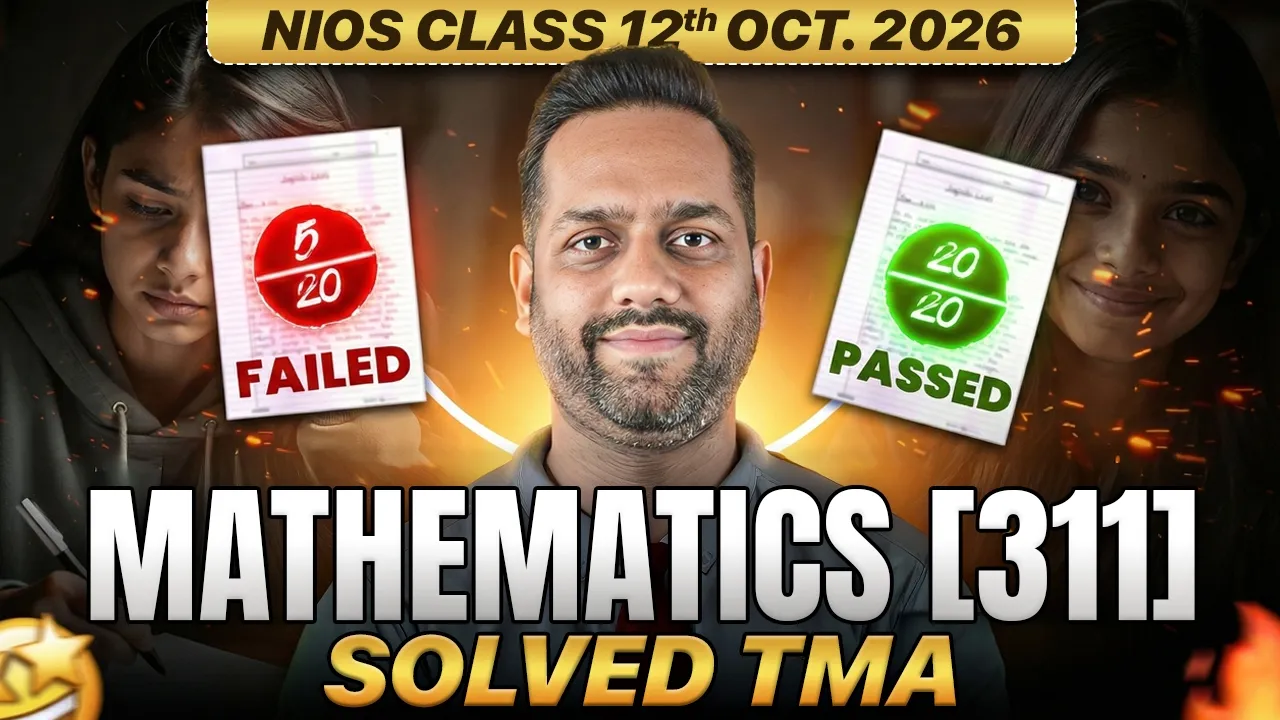
The NIOS Maths 311 solved TMA October 2026 carries 20 marks that appear directly on your final mark sheet, and most learners lose them for presentation errors rather than for wrong mathematics. This page reproduces the full October 2026 Tutor Marked Assignment for Mathematics (311) exactly as issued, works two questions end to end as models, and shows the answer format that keeps every mark on the page.
Written by Prateek Talwar, Founder, Unnati Educations. Reviewed by Rohit Sharma, Senior NIOS Counsellor. Last updated 14 July 2026.
Quick answer. The Tutor Marked Assignment for NIOS Mathematics (311), October 2026 session, contains six questions. Question 1 and Question 2 offer internal choice, Question 3 asks for 40 to 60 words, Questions 4 and 5 ask for 100 to 150 words, and Question 6 is a project. It is handwritten, submitted to your allotted study centre, and carries 20 marks weightage in the final result.
Assignment snapshot
| Subject and code | Mathematics (311), NIOS Senior Secondary, Class 12 |
| Assignment | Tutor Marked Assignment, October 2026 session |
| Number of questions | Six, with internal choice in Questions 1, 2, 4, 5 and 6 |
| Weightage | 20 marks in the final result |
| Mode | Handwritten only, submitted to the allotted study centre |
| Lessons drawn upon | Lessons 4, 5, 6, 7, 8, 9, 11, 12, 17 and 19 |
| Last date of submission | Confirm against the notification for your session on nios.ac.in or with your study centre |
NIOS Maths 311 solved TMA October 2026 question paper
Below is the complete assignment as issued for the October 2026 session. Read every instruction line carefully, because each question tells you exactly how much choice you have and which lesson it is drawn from.
Question 1. Answer any one of the following question.
Q1. According to a survey of 100 students, the number of students studying the various languages were found to be as follows:
| Subjects | No. of Students |
|---|---|
| English only | 18 |
| English but not Hindi | 23 |
| English and Punjabi | 08 |
| English (total) | 26 |
| Punjabi (total) | 48 |
| Punjabi and Hindi | 08 |
| No Language | 24 |
Find:
i) How many students were studying Hindi?
ii) How many students were studying English and Hindi?
Q2. Check whether the function is even? Find its domain.
f(x) = x / √(x² − 5x + 4)
Question 2. Answer any one of the following question.
(A) A coin has two faces i.e. head and tail. Ramesh tossed a coin three times. Find the probability of getting head and tail alternatively.
i) If the first toss is a Head.
ii) If the first toss is a Tail. (See lesson 19)
(B) Two numbers are chosen, one from each of the sets {1,2,3,4,5,6,7,8,9} and {1,2,3,4,5,6,7,8,9}. Ram calculates the probability that their sum is 10, and Shyam calculates the probability that their sum is 8. What is the product of the probabilities calculated by Ram and Shyam? (See lesson 19)
Note on the printed paper. In some copies the two target sums appear as repeated digits because of a printing fault. The intended sums are 10 and 8, which is how the marking scheme treats them.
Question 3. Answer any one of the following questions in about 40-60 words.
Q1. A factory manufactures mobile handsets. It produces 680 units in the 4th year and 780 units in the 8th year. Assuming production uniformly increases by a fixed number every year, find
i) Production in first year.
ii) Production in 11th year.
iii) The total production in 11 years. (See Lesson-6)
Q2. Find the sum of the following series up to the given number.
(1³ + 2³ + 3³ + .................... + 15³) and (1² + 2² + 3² + .................... + 15²)
Where Σn³ = [n(n+1)/2]² and Σn² = n(n+1)(2n+1)/6
Meaning of Greek word Σ is summation. Σn³ = sum of cubes of 'n' numbers. Σn² = sum of squares of numbers. (See Lesson-7)
Question 4. Answer anyone of the following questions in 100-150 words.
(a) (i) Prove that tan(60° + A) tan(60° − A) = (2cos2A + 1) / (2cos2A − 1) (See Lesson-4)
(a) (ii) Find the general value of θ satisfying tanθ + tan2θ + tan3θ = 0. (See Lesson-4)
(b) Kiran is designing a triangular park. She wants the angles of the triangle to be in Arithmetic Progression.
She also places two fences along two sides of the triangle. The lengths of these two sides are in the ratio √3 : √2. These sides lie opposite to the smallest angle and the larger angle.
To complete the design, Kiran needs to find the exact values of the three angles of the triangle. Help Kiran by finding:
i) The measures of all three angles.
ii) Which side is opposite the largest angle? (See Lesson-5)
Question 5. Answer anyone of the following questions in 100-150 words.
(a) The following is a frequency distribution of the monthly data usage (in GB) of 800 internet users recorded by a telecom company. Based on the given table, determine the following:
(i) Upper limit of the fifth class.
(ii) Lower limit of the eighth class.
(iii) Size of the class interval.
(iv) Frequency of the fourth class.
(v) Cumulative frequency of the sixth class.
(vi) Percentage of users who used 100 GB or more.
(vii) The median of the data (See Lesson – 17)
| Monthly Data Usage (in GB) | Number of Users |
|---|---|
| 40-49 | 28 |
| 50-59 | 92 |
| 60-69 | 116 |
| 70-79 | 152 |
| 80-89 | 136 |
| 90-99 | 124 |
| 100-109 | 96 |
| 110-119 | 44 |
| 120-129 | 12 |
| Total | 800 |
(b) Two statements are given one labeled assertion (A) and another labeled reason (R). Select correct answers from the codes (a), (b), (c) and (d) as given below
a) Both (A) and (R) are true and (R) in correct explanation of (A)
b) Both (A) and (R) are true and(R) in not correct explanation of (A)
c) (A) is true but (R) is false.
d) (A) is true but (R) is true.
Assertion (A): Set A has 6 observations 5,15,25,35,45,55,
Set B has 31 observation 15,16,17,18, …….43, 44, 45
It is given that mean of Set A = 30 and variance = 291.67 and mean of set B = 30 and variance = 80.
Reason (R): Dot Diagram for Set A and Dot Diagram for Set B, as printed in the assignment.
Find the correct answer and given reasons in support of your answer. (See Lesson – 17)
Question 6. Prepare any one project as given below.
(a) (I) A carpenter wants to cut three lengths from a single piece of cardboard of length 101cm. The second length is 11 cm longer than the shortest and the third length is thrice the shortest. What are the possible lengths of the shortest piece, if the third piece is atleast 8 cm longer than the second?
(a) (II) Following complex numbers are defined as z₁ = 3 − 2i, z₂ = 3 + 2i, z₃ = 1 + i
Find
(i) α = z₁ + z₂ + z₃
(ii) β = z₁ × z₂ × z₃
(iii) γ = 2z₁z₂ / z₃
(iv) Represent α, β and γ on a complex plane
(v) Find the Argument and Modulus of α, β and γ. (See Lesson – 8, 9)
(b) (i) Mr. Rohan has 7 relatives, 4 of them are ladies and 3 are men. His wife, Sunita, also has 7 relatives, 3 of them are ladies and 4 are men. In how many ways can they invite guests for a dinner party consisting of 3 ladies and 3 men, such that 3 of the guests are Mr. Rohan's relatives and the other 3 are Sunita's relatives?
(b) (ii) While discussing the dinner preparations, their daughter Ruchi is working on a math problem. She notices that the 5th, 6th, and 7th terms in the binomial expansion of (1+y)ⁿ form an arithmetic progression. Prove that the two possible values of n are such that one is double the other.
(b) (iii) For the dinner party, Mr. Rohan sets up a rectangular table. The length of the table is (x + 3) feet, and the width is (x + 1) feet. The dining room is small, so the area of the table must be less than 30 square feet. Write and solve an inequality to find the possible values of x that fit this condition. (See Lesson – 9, 11, 12)
Two model answers with complete working
These two solutions are reproduced in full so that you can see the standard of working an evaluator expects. Copy the method, not the handwriting. The remaining solutions are available on request.
Model answer 1. Question 1, Q1 (Sets and Venn regions)
Let the three languages be E (English), H (Hindi), P (Punjabi). Split the 100 students into the eight Venn regions: only E = a, only H = b, only P = c, E∩H only = d, E∩P only = e, H∩P only = f, E∩H∩P = g, none = 24.
Decoding the data.
- English only = 18, so a = 18.
- English but not Hindi = 23 means everyone in E who is not in H, so a + e = 23 and e = 23 − 18 = 5.
- English and Punjabi = 8 counts everyone studying both E and P, including those who also study H, so e + g = 8 and g = 8 − 5 = 3.
- Punjabi and Hindi = 8 similarly means f + g = 8, so f = 8 − 3 = 5.
- English total = 26 means a + d + e + g = 26, so 18 + d + 5 + 3 = 26 and d = 0.
- Punjabi total = 48 means c + e + f + g = 48, so c + 5 + 5 + 3 = 48 and c = 35.
- At least one language = 100 − 24 = 76, so a + b + c + d + e + f + g = 76, giving 18 + b + 35 + 0 + 5 + 5 + 3 = 76 and b = 10.
Final answers. i) Total studying Hindi = b + d + f + g = 10 + 0 + 5 + 3 = 18. ii) Studying English and Hindi (E∩H) = d + g = 0 + 3 = 3.
Model answer 2. Question 3, Q1 (Arithmetic Progression)
Let yearly production form an AP with first term a and common difference d.
Given, 4th term: a + 3d = 680 …(1) and 8th term: a + 7d = 780 …(2)
Subtracting (1) from (2): 4d = 100, so d = 25. From (1): a = 680 − 3(25) = 680 − 75 = 605.
i) Production in the first year: a = 605 units.
ii) Production in the 11th year: a + 10d = 605 + 10(25) = 605 + 250 = 855 units.
iii) Total production in 11 years: S₁₁ = (11/2)[2a + (11 − 1)d] = (11/2)(2 × 605 + 10 × 25) = (11/2)(1210 + 250) = (11/2) × 1460 = 11 × 730 = 8030 units.
Want the worked solutions for Questions 2, 4, 5 and 6, including the trigonometry proof, the median calculation and the complex number project with the Argand diagram? Message our NIOS team on WhatsApp at 9654279279.
How to write your NIOS Maths 311 solved TMA October 2026 answers
The evaluator marks method, presentation and completeness, not just the boxed answer. A correct result with two lines of working scores less than a correct result with a visible derivation.
- Prepare the front page carefully with your name, the enrolment number issued at your NIOS Class 12 admission, subject and code (311), study centre and session. An incomplete front page is the fastest way to lose easy marks.
- Write in blue or black pen only. Use one colour for the working and reserve the second for headings, final answers and underlining.
- State what is given and what is to be found before you start calculating.
- Show every step. Do not jump from the formula to the result, even where the arithmetic is trivial.
- Use correct notation. Write n(A), ∩, ∪, Σ and θ properly rather than approximating them.
- Draw diagrams with a pencil and a ruler, and label every region, axis and vertex.
- Box or underline the final answer of every part, and include the unit where one applies.
- Answer in your own handwriting. Identical copies submitted by two learners invite a reduction in marks.
- Respect the word limits given in Questions 3, 4 and 5.
- Complete a rough draft first, check the arithmetic, then write the fair copy.
Choice strategy, question by question
Question 1. The sets question rewards careful bookkeeping and has no tricky algebra. The function question is shorter but you must handle both the domain inequality and the evenness test correctly, and many learners forget that a domain which is not symmetric about zero already settles the question.
Question 2. Both options come from Lesson 19. Option (A) needs a conditional sample space of four outcomes. Option (B) needs you to count ordered pairs out of 81. Pick whichever you can present in the cleanest table.
Question 3. The AP option is the safer choice because every step is mechanical. The series option is fast only if you have both summation formulae committed to memory.
Questions 4 and 5. These carry the heaviest working. If your trigonometric identities are weak, take option (b) in Question 4. In Question 5, the frequency distribution is more predictable than the assertion and reason item, which asks you to justify a choice in words.
Question 6. The project needs presentation as much as mathematics. Option (a) requires an Argand diagram drawn to scale with the modulus and argument of each complex number stated clearly.
Mistakes that quietly cost marks
- Writing only the final answer with no visible method.
- Using a shortcut formula without stating it first.
- Cluttered Venn diagrams and unlabelled axes.
- Skipping the concluding statement, so the evaluator has to hunt for your answer.
- Typed or printed pages, which NIOS does not accept for a Tutor Marked Assignment.
- Submitting on the final day, leaving no margin if the study centre raises a query.
Lessons the October 2026 assignment draws upon
| Question | Topic | Lesson referenced in the paper |
|---|---|---|
| 1 | Sets, and relations and functions | Sets, and functions |
| 2 | Probability | Lesson 19 |
| 3 | Sequences and series | Lessons 6 and 7 |
| 4 | Trigonometric functions, and properties of triangles | Lessons 4 and 5 |
| 5 | Measures of dispersion and statistics | Lesson 17 |
| 6 | Complex numbers, inequalities, permutations and combinations, binomial theorem | Lessons 8, 9, 11 and 12 |
If you revise only these lessons before writing, you will still cover every question in the assignment. That focus is what makes the Tutor Marked Assignment the most predictable 20 marks available to a Mathematics learner this session.
Frequently asked questions
Is the Mathematics (311) Tutor Marked Assignment compulsory?
Yes. NIOS treats the Tutor Marked Assignment as a compulsory component for Mathematics (311), and it carries 20 marks weightage in the final result. A learner who does not submit it forfeits those marks entirely, which can be the difference between a pass and a first division. The assignment must be submitted to the allotted study centre and assessed by the tutor there.
Can I type or print my TMA answers?
No. The Tutor Marked Assignment must be handwritten in your own hand. Typed or printed submissions are not accepted, because the tutor is assessing your working, your notation and your presentation, not merely the final numerical result. Write in blue or black pen, draw diagrams in pencil with a ruler, and keep the fair copy clean and legible throughout.
What is the last date to submit the October 2026 TMA?
Submission dates are notified session by session and can differ by regional centre, so we do not publish a figure that might mislead you. Confirm the deadline for your session directly with your allotted study centre or on nios.ac.in before you plan your writing schedule. Aim to submit at least a fortnight early so that a query does not cost you the deadline.
Are the April and October TMA question papers the same?
Not necessarily. NIOS issues the assignment session by session, so you should always work from the paper marked for your own session. The version reproduced on this page is the Mathematics (311) Tutor Marked Assignment for the October 2026 session. Match the session printed on your assignment against the one you are enrolled for before you begin writing.
How many questions must I actually answer?
All six questions must be attempted, but most of them carry internal choice. Questions 1 and 2 ask for any one of the given options, Question 3 asks for any one, Questions 4 and 5 ask for any one, and Question 6 asks you to prepare any one project. So you write six answers in total, choosing the option you can present most completely.
Can two learners submit the same TMA answers?
It is risky. Tutors read assignments from the same study centre together, and identical wording or identical presentation invites a reduction in marks for both learners. Use a model answer to understand the method, then rebuild the working in your own hand and your own sequence of steps. The mathematics may be identical, but the writing should be yours.
Where do the October 2026 questions come from in the syllabus?
The assignment draws on Lessons 4, 5, 6, 7, 8, 9, 11, 12, 17 and 19 of the Mathematics (311) course. That covers trigonometric functions, properties of triangles, sequences and series, complex numbers, quadratic equations and inequalities, permutations and combinations, the binomial theorem, measures of dispersion and probability. Revising those lessons is enough to attempt every question on the paper.
Do you provide handwritten assignments and past papers?
Yes. Alongside this paper you can browse our wider NIOS Solved TMA collection, and Unnati Educations also supplies handwritten assignment copies, practical files, chapter-wise objective and in-text question booklets, and solutions to the last five years of Mathematics (311) question papers with full explanations. Online and offline tuition, including one to one sessions, can be arranged. Send your requirement on WhatsApp and our team will respond with the available options.
Get the complete solutions
Solved Tutor Marked Assignments, handwritten assignment copies, practical files and last five years of solved question papers for NIOS Class 12 Mathematics are available from our team. If you are also guiding a younger learner, the matching NIOS Class 10 solved tma paper sits on its own page. Send your subject code and session on WhatsApp to 9899436384.
Disclaimer
Unnati Educations is an independent academic support platform and is not affiliated with, endorsed by or connected in any way to the National Institute of Open Schooling (NIOS). The assignment text on this page is reproduced from the Mathematics (311) Tutor Marked Assignment issued for the October 2026 session, for study reference.
Model answers are provided to illustrate method and presentation. Learners must write their own submissions in their own handwriting. Confirm submission dates and assignment validity with your allotted study centre or on nios.ac.in before submitting.