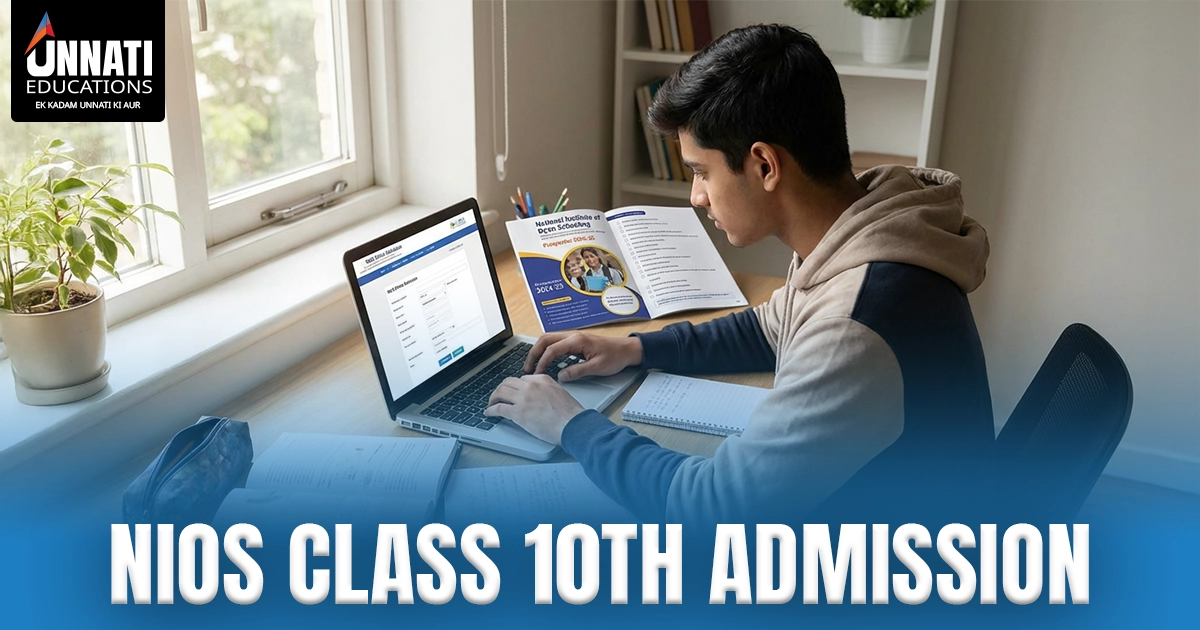
Short answer: NIOS Class 10th admission runs through Stream 1 in two blocks. Block 1 opened on 16 March 2026 and closes without a late fee on 31 July 2026, with exams in April and May 2027. Block 2 opens on 16 September 2026 and closes without a late fee on 31 January 2027, with exams in October and November 2027. You must be at least 14 years old. Applications are filed at sdmis.nios.ac.in.
Written by Prateek Talwar (Founder, Unnati Educations) | Reviewed by Rohit Sharma, Senior NIOS Counsellor | Last updated: 14 July 2026
Anyone applying in the current Block 1 window has roughly two weeks left before the no-late-fee deadline of 31 July 2026. That single date drives most of the panic we hear on our helpline every July, so this guide puts it first rather than burying it. Everything below covers the Stream 1 route for the Secondary course, which is the NIOS equivalent of Class 10 on any recognised Indian board.
What NIOS Class 10th Admission Actually Means
The NIOS Secondary course carries the same academic standing as Class 10 from CBSE or a state board. It is not a shortcut or a lesser qualification. It is a different delivery model built for learners who cannot or do not want to sit in a classroom for six hours a day.
Three things separate it structurally from regular schooling. Attendance is not compulsory. Subjects are chosen by the learner rather than assigned by a school. And the registration stays alive for five years, across nine examination chances, instead of expiring the moment one exam session goes badly.
That last point is the one most families underestimate. A regular board treats a failed year as a lost year. NIOS treats it as one attempt out of nine.
Stream 1 Block 1 and Block 2 Compared
Stream 1 is the route for fresh learners entering the Secondary course for the first time. It splits into two admission blocks that differ only in timing. The certificate, the NIOS syllabus, the paper standard and the recognition are identical.
| Feature | Block 1 | Block 2 |
|---|---|---|
| Window without late fee | 16 March 2026 to 31 July 2026 | 16 September 2026 to 31 January 2027 |
| Late fee phases | 1 August to 15 September 2026 | 1 February to 15 March 2027 |
| Portal closes permanently | 15 September 2026 | 15 March 2027 |
| Public examination session | April and May 2027 | October and November 2027 |
| Age counted as on | 31 July 2026 | 31 January 2027 |
| Best suited to | Learners ready to begin studying now | Learners finishing another commitment first |
| Certificate and recognition | Identical | Identical |
Choose Block 1 if you can start studying this summer. Choose Block 2 if you are waiting on a result, a relocation or a family situation to settle. There is no quality difference between them, and no employer or college can tell which block a learner came through.
Who Can Apply and What the Age Rule Really Says
The eligibility conditions for NIOS admission are deliberately wide, because the Secondary course exists to bring learners back rather than to filter them out.
- Minimum age of 14 years, counted as on the last date of the block you are applying in, not on the date you fill the form.
- Class 8 passed from a recognised institution, evidenced by a marksheet or a transfer certificate.
- Self-certification is accepted where no Class 8 marksheet exists. The learner declares that they have studied enough to cope with the Secondary course.
- Identity and address proof in the applicant's own name or a guardian's name.
- No upper age limit. A 30-year-old and a 15-year-old apply through the same form.
The self-certification clause is the one that rescues most of the learners who come to us. Lost school records, a closed private school, a family that moved twice, a marksheet nobody can trace: none of these block the application.
Documents Checklist for the sdmis.nios.ac.in Portal
Rejections at this stage are almost never about eligibility. They are about a blurred scan, a wrong file size or a name that reads differently on two documents. Prepare all of the following before opening the form.
- Age proof such as a birth certificate, Aadhaar or a school record showing date of birth
- Class 8 marksheet, transfer certificate, or a self-certification where neither exists
- Recent passport-size photograph on a plain background
- Scanned signature on white paper
- Government photo identity such as Aadhaar, passport or voter card
- Address proof such as a ration card, electricity bill or voter card
- Caste certificate, where a category concession is being claimed
- Disability certificate, where applicable
- Ex-serviceman category proof, where applicable
Two practical rules we apply to every file before upload. Scan in daylight rather than photographing under a tube light, and make the spelling of the learner's name identical across every single document. Those two habits remove most verification delays.
Step by Step Online Form Process
The whole application is completed at sdmis.nios.ac.in. There is no offline route and no physical form for Stream 1.
Register on the portal
Enter name, date of birth, category and a mobile number that will stay active for the next five years. Every future notification, from TMA reminders to examination centre allotment, goes to this number.
Complete personal and academic details
Fill in address, gender, identity number and previous qualification. This is where name mismatches surface. Correcting them later means a separate correction request, so read the confirmation screen twice.
Upload the documents
The portal enforces its own file size and format limits. Anything blurred, cropped or over the size cap is a rejection risk, and the rejection arrives weeks later rather than immediately.
Choose subjects and medium
Five subjects minimum, with at least one language. The medium options include Hindi, English and several regional languages, and the medium can differ from the language subject chosen.
Select the study centre and examination centre
Pick a centre you can physically reach on an examination morning. Learners routinely pick a well-reviewed centre across the city and then struggle to get there at 9 am with a practical file in hand.
Pay and download the confirmation
Submit the fee and save the confirmation slip as a PDF immediately. Screenshots are not accepted as proof if a payment fails to reconcile.
Stuck on a document or a subject choice? Send us a message on WhatsApp at 9654279279 and we will check the file before you upload it.
NIOS Class 10th Admission Dates and Late Fee Phases
Late fee phases are progressive. The amount rises at each stage, and the portal shuts completely at the end of the final phase. There is no extension, no appeal and no reopening.
| Phase | Block 1 (2026) | Block 2 (2026 to 2027) |
|---|---|---|
| No late fee | 16 March to 31 July 2026 | 16 September 2026 to 31 January 2027 |
| Late fee phase 1 | 1 August to 15 August 2026 | 1 February to 15 February 2027 |
| Late fee phase 2 | 16 August to 31 August 2026 | 16 February to 28 February 2027 |
| Late fee phase 3 | 1 September to 15 September 2026 | 1 March to 15 March 2027 |
| Portal closes | After 15 September 2026 | After 15 March 2027 |
[VERIFY] Late fee amounts and the base admission fee are quoted inconsistently across third-party sites, so we have deliberately left rupee figures out of this table. Confirm the current slabs on the payment screen at sdmis.nios.ac.in before you pay, since NIOS revises them by session.
Subjects and the Credit Requirement
The Secondary course runs on a credit model. A learner registers for a minimum of five subjects and a maximum of seven, and must pass at least five, of which one must be a language, to earn the certificate.
Languages available include Hindi, English, Urdu, Sanskrit, Bengali, Marathi, Gujarati, Punjabi, Telugu, Malayalam, Odia, Tamil, Kannada, Assamese, Nepali and Arabic. Alongside these sit Mathematics, Science and Technology, Social Science, Economics, Business Studies, Home Science, Psychology, Data Entry Operations, Accountancy and Painting.
Subject choice deserves more thought than most families give it. A learner who reads comfortably in Hindi and picks English literature because it sounds better on paper is choosing a harder examination for no gain. Pick the subjects the learner can actually pass, then line up the right NIOS study material for that exact combination.
Examination Pattern Validity and Attempts
- Theory papers run for three hours. Painting runs for two and a half hours.
- Practical examinations apply to Science and Technology, Home Science, Data Entry Operations, Psychology and Painting.
- Registration stays valid for five years and covers nine examination chances.
- Transfer of Credit lets a learner carry over up to two already-passed subjects from a recognised board.
- Tutor Marked Assignments carry internal weightage and must be submitted to the allotted study centre.
- On-Demand Examinations are available for many Secondary subjects, letting a learner sit a paper when ready instead of waiting for the session.
The five-year validity is what makes NIOS forgiving. A learner who clears three subjects in April and two in October still finishes the certificate, and the marksheet does not record how many sessions it took.
What Class 10 from NIOS Opens Up Next
The Secondary certificate is recognised by all AIU-member universities and by central and state government recruiting bodies. It is accepted for Class 11 admission in schools, for polytechnic and ITI entry, for vocational diplomas, and for competitive examinations that require a Class 10 qualification.
A learner who takes a second route to Class 10 has not narrowed anything. They have taken longer over a decision that most 15-year-olds are made to take in a hurry.
Where Learners Actually Get Stuck
After guiding several admission cycles, the failure points repeat with unusual consistency. They are worth naming, because none of them are about intelligence or effort.
- Missing the block deadline by days. Families treat 31 July as soft. It is not.
- Choosing subjects for prestige. The certificate does not distinguish between an easy subject and a hard one.
- Ignoring TMAs. They carry internal marks and are the cheapest marks on offer in the entire course.
- Picking an unreachable examination centre. Convenience on the form becomes a crisis on examination morning.
- Assuming registration expires with one failure. It runs for five years.
Frequently Asked Questions
When does NIOS Class 10th admission start and close?
Stream 1 runs twice a year. Block 1 opened on 16 March 2026 and closes without a late fee on 31 July 2026, with late fee phases running until 15 September 2026. Block 2 opens on 16 September 2026 and closes without a late fee on 31 January 2027, with late fee phases until 15 March 2027. Choose the block that matches when you can begin studying.
What is Stream 1 in the NIOS Secondary course?
Stream 1 is the admission route for fresh learners registering for the Secondary course for the first time. It divides into Block 1, which leads to the April and May examination session, and Block 2, which leads to the October and November session. Learners repeating a failed board examination from another board may instead qualify for Stream 2, which has its own separate window.
Who is eligible for admission to NIOS Class 10?
A learner must be at least 14 years old as on the closing date of the block, and should have passed Class 8 from a recognised institution. Where no Class 8 marksheet is available, NIOS accepts a self-certification stating that the learner has studied enough to cope with the Secondary course. There is no upper age limit on the Secondary course.
Can I still apply after the last date has passed?
Yes, but only within the late fee phases. Once the no-late-fee date passes, three progressive late fee windows follow before the portal closes permanently. For Block 1 the final cut-off is 15 September 2026, and for Block 2 it is 15 March 2027. After the final phase closes there is no extension, so the next option is the following block.
How long does the registration stay valid?
Registration remains valid for five years from the date of admission, and covers nine examination chances across that period. Within that time a learner can reappear in subjects not yet cleared, or reattempt a subject to improve the score. This is why illness, relocation or a difficult year does not force a learner to restart the Secondary course from the beginning.
Is the NIOS Class 10 certificate valid for Class 11 and government jobs?
Yes. The Secondary certificate is issued by an autonomous board under the Ministry of Education and carries the same standing as CBSE or a state board for Class 11 admission, polytechnic and ITI entry, and government recruitment that requires a Class 10 qualification. Schools and recruiters cannot distinguish between a Block 1 and a Block 2 certificate.
How many subjects must I take in NIOS Class 10?
A learner registers for a minimum of five subjects and may take up to seven. At least one must be a language, and at least five subjects must be passed for certification. Taking more than five gives a buffer, since the certificate is awarded on the best-performing subjects. Practical subjects carry an additional practical examination alongside the theory paper.
Get the Form Filled Correctly the First Time
Most of what goes wrong in this process is preventable, and almost all of it is preventable before submission rather than after. We review the documents, sanity-check the subject combination and confirm the block before the payment screen.
Talk to a counsellor: WhatsApp 9654279279 or 9899436384.
Sources and Disclaimer
Sources: National Institute of Open Schooling official portal (nios.ac.in), Student Data Management and Information System (sdmis.nios.ac.in) and the NIOS Prospectus for the 2026 to 2027 session. Dates verified on 14 July 2026. NIOS revises schedules and fees by session, so confirm current details on the official portal before applying.
Disclaimer: Unnati Educations is an independent academic support provider. We are not affiliated with, endorsed by, or an agent of the National Institute of Open Schooling. We do not process admissions on behalf of NIOS. All applications are submitted by learners directly on the official NIOS portal.