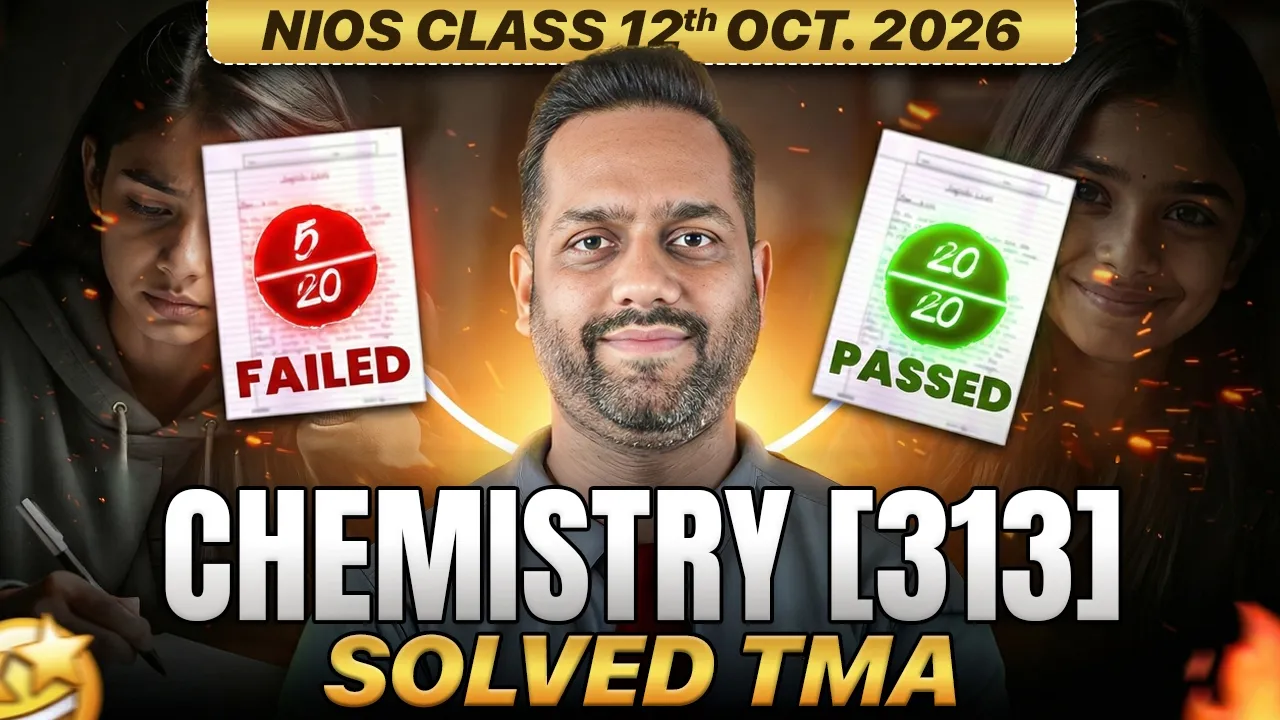
The NIOS Chemistry 313 Solved TMA is the only part of your Chemistry result you can complete with the book open, no clock running and no invigilator watching. It carries 20 per cent weightage, and every question on it prints a lesson number in brackets telling you exactly where the answer must come from.
On this page you get the complete Chemistry (313) Tutor Marked Assignment for October 2026 reproduced as issued, two fully worked sample answers, the writing format evaluators reward, and the mistakes that quietly drain marks from otherwise capable learners.
Written by Prateek Talwar, Founder, Unnati Educations. Reviewed by Rohit Sharma, Senior NIOS Counsellor.
Quick Answer for Learners in a Hurry
The Chemistry (313) Tutor Marked Assignment for the October 2026 session contains short-answer questions of 40 to 60 words, long-answer questions of 100 to 150 words, and one project with a choice of two case studies. It is handwritten, submitted to your allotted study centre, and carries 20 per cent weightage in the final Chemistry result. Every question names the NIOS lesson it is drawn from. Learners who have just completed their nios class 12 Admission should treat this assignment as their first bankable marks of the session. The complete paper is reproduced below.
The Detail Almost Every Learner Skips
Look at the very first question on the paper. After the question text, in brackets, it says (See Lesson – 3).
That is NIOS telling you where the answer lives. It does not say consult a search engine. It does not say ask an AI tool. It names a lesson in the official NIOS Chemistry study material, and it does that on question after question.
This matters more in Chemistry than in almost any other subject. Generic sources use different notation, write American spellings such as sulfur where the NIOS book uses sulphur, quote reaction mechanisms outside the syllabus, and skip the exact terminology an evaluator is trained to look for. Open Lesson 3, read it, then write. A learner who does that is already ahead of most of the submissions in the pile.
Marks Distribution and Submission
| Component | Weightage |
|---|---|
| Tutor Marked Assignment (TMA) | 20 per cent |
| Public examination (theory) | 80 per cent |
The assignment must be handwritten by the learner and submitted to the allotted study centre before the cut-off announced by NIOS for the October 2026 session. Confirm the current submission date on the official NIOS website at nios.ac.in, because it is revised each session and late submissions are marked more strictly or refused outright. Keep a scan or photocopy of the completed assignment before you hand it in.
NIOS Chemistry 313 Solved TMA October 2026 Complete Question Paper
The Chemistry (313) Tutor Marked Assignment for October 2026 is reproduced below exactly as issued. Note that the printed paper repeats the numbers 2 and 3 for two separate questions. The sequence below preserves the order in which the questions appear on the paper, with the printed number noted alongside so you can match it to your own copy.
Question 1 (printed as 1). Answer any one of the following questions in about 40 to 60 words.
(a) Classify the elements of group 14, 15 and 16 into metals, non-metals and metalloids. (See Lesson – 3)
(b) Compare the metallic character of aluminium and potassium. (See Lesson – 3)
Question 2 (printed as 2). Answer any one of the following questions in about 40 to 60 words.
(a) Why does the application of alum to a fresh cut wound help stop bleeding?
(b) Two beakers A and B contain ferric hydroxide sol and NaCl solution respectively. When a beam of light is allowed to converge on them in a darkened room, the beam of light is visible in beaker A but not in beaker B. Give the reason. What is this effect called?
Question 3 (also printed as 2). Answer any one of the following questions in about 40 to 60 words.
(a) In the given chemical reactions, indicate whether you would expect the entropy of the system to increase or decrease.
(i) 2SO₂ (g) + O₂ (g) → 2SO₃ (g)
(ii) N₂ (g) + 3H₂ (g) → 2NH₃ (g)
(b) Give reason for the following.
(i) Neither heat (q) nor work (w) is a state function but q + w is a state function.
(ii) A real crystal has more entropy than an ideal crystal.
Question 4 (printed as 3). Answer any one of the following questions in 100 to 150 words.
(a) Write down the reactions involved during the formation of photochemical smog.
(b) Write down the reactions involved for ozone layer depletion in the stratosphere.
Question 5 (also printed as 3). Answer any one of the following questions in 100 to 150 words.
(a) Explain the pattern of variation in the oxidation states of (i) B to Tl and (ii) C to Pb.
(b) Consider the compounds BCl₃ and CCl₄. How will they behave with water? Justify your answer.
Question 6 (printed as 4). Prepare any one project as given below.
(a) On the occasion of World Health Day, Dr Satpal organised a health camp for the poor farmers living in a nearby village. After check-up, he was concerned to see that most of the farmers suffered from severe allergies, including hay fever and persistent itching of the eyes, nose and throat, due to prolonged exposure to airborne pollutants and pesticides. He distributed antihistamines at no cost and advised preventive measures.
Dr Satpal immediately reported the matter to the National Human Rights Commission (NHRC). On the suggestions of NHRC, the government decided to launch awareness programmes, provide medical care and financial assistance, and implement eco-friendly agricultural practices to reduce allergic diseases among farmers across India.
(i) Write the values shown by (a) Dr Satpal and (b) NHRC.
(ii) What types of antihistamines are commonly used for the treatment of hay fever and allergic symptoms?
(iii) Give an example of an artificial sweetener that can be recommended to diabetic patients.
(b) Mr Naresh works in a multinational company. He is stressed due to his hectic schedule. Mr Amit, his friend, comes to know that he has started taking sleeping pills without consulting the doctor. Mr Amit requests Naresh to stop this practice and takes him to a yoga centre. With regular yoga sessions, Mr Naresh is now a happy and relaxed man.
After reading the above passage, answer the following questions.
(i) Write the values shown by Mr Amit to Mr Naresh in your own words.
(ii) Which class of drugs is used in sleeping pills?
(iii) Why is it not advisable to take sleeping pills without consultation with the doctor?
Two Sample Answers from the NIOS Chemistry 313 Solved TMA
Read these for structure, not for wording. Notice how each one answers the question in its opening line, uses NIOS terminology, and closes with the general principle rather than trailing off.
Model Answer: Question 1(a), Metals, Non-Metals and Metalloids
Group 14: carbon and silicon are non-metals, germanium is a metalloid, and tin and lead are metals.
Group 15: nitrogen and phosphorus are non-metals, arsenic and antimony are metalloids, and bismuth is a metal.
Group 16: oxygen, sulphur and selenium are non-metals, tellurium is a metalloid, and polonium is a metal.
Thus non-metals dominate the upper members, metalloids occur in the middle, and metallic nature increases down each group because of larger atomic size, lower ionisation energy and stronger metallic bonding.
Why this earns full credit: it classifies every element the question asks about, group by group, and then supplies the underlying trend in a single closing sentence. It sits inside the 40 to 60 word limit and it is drawn from Lesson 3, exactly as the paper instructs.
Model Answer: Question 2(b), The Tyndall Effect
Ferric hydroxide sol is a colloidal system. Its dispersed particles are large enough to scatter the incident light, which makes the path of the beam visible in beaker A. This scattering of light by colloidal particles is called the Tyndall effect.
Sodium chloride solution is a true solution. Its particles are of ionic dimensions and far too small to scatter light appreciably, so no beam is seen in beaker B. Hence beaker A shows the Tyndall effect and beaker B does not.
Why this earns full credit: it names the effect explicitly, gives the physical reason on both sides of the comparison, and distinguishes a colloid from a true solution using particle size. The evaluator can tick each required element without hunting for it.
Need the rest of the paper solved? Questions 1(b), 2(a), 3(a), 3(b), 4(a), 4(b), 5(a), 5(b) and both project options in Question 6 are worked out in full, with balanced reaction sequences for smog and ozone depletion and complete value-based project answers. Message the NIOS desk on WhatsApp at 9654 279 279, or use 9899 436 384. Available in English medium and Hindi medium, as a PDF or as a handwritten assignment.
Writing Format That Evaluators Reward
Headings in Black Pen, Answers in Blue Pen
Write the question number and any heading in black ink, then write the body of the answer in blue ink. Rule any table in pencil. This single convention makes a script instantly readable and signals that you took the assignment seriously. It costs nothing and it is the first thing the evaluator notices.
Respect the Word Limit
A 40 to 60 word question does not want a page. Chemistry marks are awarded for the correct term, the correct trend and the correct reason, not for volume. Padding a short answer buries the point the evaluator is looking for and wastes the time you should be spending on the 100 to 150 word questions and the project.
Write Equations, Not Descriptions of Equations
For the photochemical smog and ozone depletion questions, the paper says write down the reactions. Write the balanced steps as chemical equations, one per line, with the condition such as hv above the arrow. A paragraph describing what happens will not earn what a correctly written reaction sequence earns.
Rewrite in Your Own Words and Your Own Hand
Use our solutions to understand the reasoning, then rebuild each answer in your own sentences. Every file in our NIOS Solved TMA library is meant as a model to learn from, not to copy line for line. Identical wording across submissions is the fastest route to a deduction. Same chemistry, your voice, your handwriting.
Do Not Overload the Script with Diagrams
Chemistry is not Physics here. Draw a figure only where it genuinely helps, such as a structure or a labelled setup. Decorative diagrams add nothing and clutter the answer. Precision earns marks; ornamentation does not.
Mistakes That Cost Chemistry Marks Every Session
- Writing from a general web source when the question names a NIOS lesson.
- Attempting both options when the paper clearly says answer any one.
- Describing a reaction in prose instead of writing the balanced equation.
- Forgetting the closing trend or principle sentence, which is where the final mark usually sits.
- Illegible handwriting. An answer that cannot be read cannot be awarded marks.
- Submitting after the study centre cut-off and losing the entire 20 per cent.
Pair the TMA with Five Years of Question Papers
The assignment teaches you the syllabus. Previous year papers teach you the examination. Chemistry topics recur across sessions even when the format shifts between multiple choice, true or false, fill in the blanks and passage-based questions. Working through five years of Chemistry (313) papers with full explanations alongside your assignment is the most reliable preparation available. Our NIOS Class 12 solved tma hub keeps every subject in one place for quick reference. Practical file guidance and viva questions for Chemistry are also available through our NIOS desk.
Frequently Asked Questions
Is the NIOS Chemistry 313 TMA compulsory?
Yes. The Tutor Marked Assignment is a compulsory component of the Chemistry (313) course and carries 20 per cent weightage in your final result. A learner who does not submit it forfeits that entire portion, which is very difficult to recover through the theory paper alone. Treat it as the most controllable marks available to you in the whole course.
Are the October 2026 Chemistry TMA questions different from earlier sessions?
NIOS releases a session-specific assignment, so you must complete the paper issued for your own admission session. The October 2026 Chemistry (313) paper reproduced on this page is the current one. Themes such as periodic classification, colloids, thermodynamics, environmental chemistry and chemistry in everyday life recur across sessions, but the exact wording and lesson references change every time.
Can I write Chemistry TMA answers using AI or a search engine?
It is a weak strategy. Each question prints a lesson reference such as See Lesson 3, which means NIOS expects the answer to come from its own study material. Outside sources often use different notation, American spellings and content beyond the syllabus, none of which matches what the evaluator is trained to reward. Read the named lesson, then write the answer yourself.
What is the word limit for Chemistry TMA answers?
Short-answer questions carry a limit of about 40 to 60 words. Long-answer questions carry a limit of about 100 to 150 words. The project question is longer and is broken into parts. Staying inside the limit matters, because Chemistry marks are awarded for the correct term and the correct reason rather than for the length of the answer.
Where can I get the complete Chemistry 313 solved TMA for October 2026?
Unnati Educations provides the full worked solution set for Chemistry (313), covering every question and both project options, with balanced equations and complete value-based answers. It is available in English medium and Hindi medium, as a PDF or as a handwritten assignment. Message the NIOS desk on WhatsApp at 9654 279 279 or 9899 436 384 to receive it.
What happens if I submit my Chemistry TMA late?
Late assignments are evaluated more strictly and may not be accepted at all once the cut-off announced by NIOS for the session has passed. Submit the handwritten assignment to your allotted study centre well before the last date, obtain an acknowledgement where possible, and keep a scan for your records. Study centres see a heavy rush in the final week.
Disclaimer
Unnati Educations is an independent academic support platform and is not affiliated with, endorsed by, or associated with the National Institute of Open Schooling (NIOS) or any government body. The Chemistry (313) question paper reproduced above is shown for reference and study purposes only. Learners must confirm assignment details, submission dates and evaluation criteria on the official NIOS website at nios.ac.in.