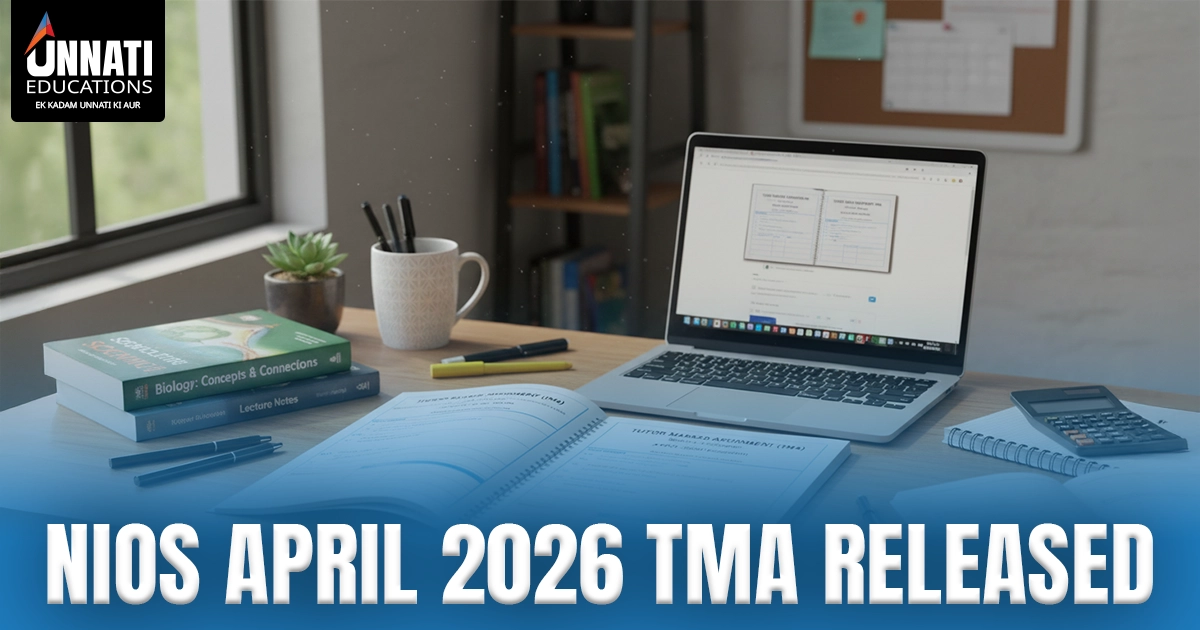
The NIOS April 2026 TMA is the Tutor Marked Assignment component that every Stream 1 learner at Secondary and Senior Secondary level must complete alongside the public examination. It is not optional homework and it is not a formality. Each assignment carries 20 marks out of the 100 marks fixed for that subject, which means it sits on your marksheet permanently.
This guide explains the weightage, the writing pattern, the subject codes for both classes, the submission rules, and the mistakes that quietly cost learners marks every session.
Written by Prateek Talwar, Founder, Unnati Educations. Reviewed by Rohit Sharma, Senior NIOS Counsellor. Last updated 14 July 2026.
Key Facts at a Glance
| Item | Detail |
|---|---|
| Full form of TMA | Tutor Marked Assignment |
| Marks per subject | 20 out of 100 (theory paper carries the other 80) |
| Who must submit | Stream 1 learners, Secondary and Senior Secondary |
| Number of assignments | One per registered subject |
| Writing mode | Handwritten in the learner's own words |
| Submitted to | The learner's Accredited Institution (AI) or study centre |
| Class 10 subject codes covered | 201 to 285 (38 codes listed below) |
| Class 12 subject codes covered | 301 to 385 (45 codes listed below) |
| Where marks appear | As a separate internal assessment column on the NIOS marksheet |
Learners searching for the NIOS April 2026 TMA usually want three things: the correct question set for their subject code, an understanding of how the 20 marks are awarded, and confirmation of the submission window. All three are covered below, in that order.
NIOS April 2026 TMA Marks Weightage and How Scoring Works
Every NIOS theory subject is scored out of 100. The public examination paper carries 80 marks. The assignment carries the remaining 20 marks. These two scores are added together, subject by subject, to produce the figure printed on your marksheet.
The arithmetic is worth doing once, slowly, because most learners have never done it.
- Theory paper: 67 out of 80
- Assignment: 16 out of 20
- Final subject score: 83 out of 100
The same learner who skips the assignment finishes with 67 out of 100 for that subject. Nothing about their theory preparation changed. Sixteen marks simply went uncollected. Repeat that across five subjects and the difference between a 67 percent marksheet and an 83 percent marksheet is entirely the assignment file.
This matters most for learners applying for scholarships, government recruitment, or undergraduate courses with a minimum percentage cut-off. Those cut-offs read the aggregate, not the theory score alone.
How Assignment Marks Are Actually Awarded
The evaluator at your Accredited Institution is not counting pages. Marks are awarded against four things, and knowing them changes how you write.
- Correctness against the syllabus. Facts, definitions and steps must match the NIOS lesson, not a general internet answer.
- Completeness. A question with three parts needs three parts answered. Partial answers lose partial marks, every time.
- Presentation. Numbered answers, clean margins, labelled diagrams, legible handwriting.
- Your own words. Copied textbook paragraphs read as copied textbook paragraphs. Evaluators recognise them instantly.
The project or observation task inside each assignment usually carries the single largest block of marks. It is also the task most learners rush. A well-planned project written to the stated word limit is the most reliable way to move from 13 marks to 18.
What Goes Into a Well-Written Assignment Answer
Short answer questions test whether you understood the concept. Long answer questions test whether you can explain it in sequence. Application questions test whether you can move the concept into a real situation. Each needs a different shape.
A structure that works across every subject:
- Open with a one-line definition or direct statement of the point. Do not warm up.
- Develop the body in short, numbered points rather than one long block.
- Add one concrete example drawn from your own surroundings, not a stock example.
- Close with a single summarising sentence. Introduce nothing new there.
- Match the length to the marks. A two mark question does not want a page.
Writing more is not the same as scoring more. A tight, correct, well-laid-out answer beats three padded pages in every NIOS evaluation scheme we have seen across sessions. Learners who want a worked model to write against can read through our NIOS Solved TMA reference before drafting their own version in their own words.
Mistakes That Cost Learners Marks Every Session
The same handful of errors reappear in file after file. None of them are difficult to avoid.
- Treating the assignment as a formality and writing it the night before submission.
- Copying textbook lines word for word without understanding them.
- Leaving one or two questions unattempted because they looked long.
- Answering out of order, so the evaluator cannot match answers to question numbers.
- Writing two-line answers to questions that carry five marks.
- Entering the wrong subject code or leaving the enrolment number blank on the cover page.
- Skipping the project task entirely, which is where the largest mark block sits.
That last pair is the cruellest. A file can be well written and still lose marks because the cover page was filled in carelessly.
NIOS April 2026 TMA Submission Rules and Deadline
Submission rules are set by NIOS for each examination cycle and are published in the session notification. Learners should confirm the exact date for their own session on the official NIOS portal before planning around it.
What holds true across cycles:
- The assignment is written by hand on plain sheets, with the official NIOS front page attached.
- The front page must carry your name, enrolment number, subject name, subject code and study centre code.
- One completed file is submitted per registered subject.
- The file is submitted to your Accredited Institution within the window announced for your session.
- Late submission is not accepted once the window closes for that cycle.
Class 10 Secondary Subject Codes for the Assignment
Assignments are issued against subject codes, not subject names. Pull the code from your admission confirmation, then match it here. Thirty-eight Secondary codes are currently covered.
| Code | Subject |
|---|---|
| 201 | Hindi |
| 202 | English |
| 203 | Bengali |
| 204 | Marathi |
| 205 | Telugu |
| 206 | Urdu |
| 207 | Gujarati |
| 208 | Kannada |
| 209 | Sanskrit |
| 210 | Punjabi |
| 211 | Mathematics |
| 212 | Science and Technology |
| 213 | Social Science |
| 214 | Economics |
| 215 | Business Studies |
| 216 | Home Science |
| 222 | Psychology |
| 223 | Indian Culture and Heritage |
| 224 | Accountancy |
| 225 | Painting |
| 229 | Data Entry Operations |
| 230 | Indian Sign Language |
| 231 | Nepali |
| 232 | Malayalam |
| 233 | Odia |
| 235 | Arabic |
| 236 | Persian |
| 237 | Tamil |
| 238 | Sindhi |
| 243 | Carnatic Music |
| 244 | Folk Arts |
| 245 | Veda Adhyayan |
| 246 | Sanskrit Vyakarana |
| 247 | Bharatiya Darshan |
| 248 | Sanskrit Sahitya |
| 258 | Logistics and Supply Chain Management |
| 259 | Warehouse Principles and Inventory Management |
| 285 | Natyakala |
Full question sets and subject-wise guidance for every Secondary code sit on the NIOS Class 10 TMA page.
Class 12 Senior Secondary Subject Codes for the Assignment
Senior Secondary assignments run on the 300 series. Forty-five codes are currently covered, including the language, science, commerce, humanities and vocational groups.
| Code | Subject |
|---|---|
| 301 | Hindi |
| 302 | English |
| 303 | Bengali |
| 304 | Tamil |
| 305 | Odia |
| 306 | Urdu |
| 307 | Gujarati |
| 309 | Sanskrit |
| 310 | Punjabi |
| 311 | Mathematics |
| 312 | Physics |
| 313 | Chemistry |
| 314 | Biology |
| 315 | History |
| 316 | Geography |
| 317 | Political Science |
| 318 | Economics |
| 319 | Business Studies |
| 320 | Accountancy |
| 321 | Home Science |
| 328 | Psychology |
| 330 | Computer Science |
| 331 | Sociology |
| 332 | Painting |
| 333 | Environmental Science |
| 335 | Mass Communication |
| 336 | Data Entry Operations |
| 337 | Tourism |
| 338 | Introduction to Law |
| 339 | Library and Information Science |
| 340 | Gender Studies |
| 341 | Arabic |
| 342 | Persian |
| 343 | Malayalam |
| 344 | Sindhi |
| 345 | Veda Adhyayan |
| 346 | Sanskrit Vyakaran |
| 347 | Bhartiya Darshan |
| 348 | Sanskrit Sahitya |
| 373 | Physical Education and Yoga |
| 374 | Military Studies |
| 375 | Military History |
| 376 | Early Childhood Care and Education |
| 385 | Natyakala |
Question sets and code-wise guidance for Senior Secondary are on the NIOS Class 12 TMA page.
Class 10 and Class 12 Assignments Are Not the Same Task
Both classes work to the same 20 mark scheme, but the evaluator reads them differently.
Secondary files are marked on clarity, completeness and presentation. A learner who defines the term, gives two correct points and draws a clean labelled diagram is close to full marks on most questions. Worked examples for these codes sit in our NIOS Class 10 solved TMA set, which pairs well with the official question paper while you write.
Senior Secondary files are marked on reasoning. A definition alone will not carry a long answer question. The evaluator is looking for a stated position, supporting points, and a conclusion that follows from them. Subjects like Political Science, Economics, Sociology and Psychology reward an argument; Physics, Chemistry and Accountancy reward complete working shown step by step. Model responses for these papers are gathered in our NIOS Class 12 solved TMA set for reference before you commit answers to the file.
Video Walkthrough of the Assignment Pattern
A short walkthrough covering the pattern, the mark split and the errors listed above is available here: watch the NIOS assignment pattern explainer. It runs under a minute and works well as a revision check before you start writing.
A Sensible Order of Work
- Confirm your subject codes from your admission or enrolment record.
- Download the question set issued for each of those codes.
- Read the whole set once before writing a single answer.
- Write the project or observation task first, while you have time to do it properly.
- Work through the short and long answer questions in question order.
- Attach the official NIOS front page and complete every field on it.
- Self-check against the four marking criteria listed earlier.
- Submit well inside the window announced for your session.
Submitting early is not just about safety. It leaves the last stretch before the theory paper clear for revision, which is where the other 80 marks live.
How Unnati Educations Supports Learners
We work with NIOS learners at Secondary and Senior Secondary level across Delhi NCR and, through WhatsApp, across India and overseas. Our support on assignments covers subject code confirmation, question set clarification, answer structuring, project planning, front page completion, and a review pass before submission. Guidance is available in Hindi and English medium.
For assignment guidance, message our NIOS team on WhatsApp at 9654279279.
Related resources on this site include the NIOS Class 10 question papers, the NIOS Class 12 question papers, and the Class 10 syllabus breakdown.
Frequently Asked Questions
What is the NIOS April 2026 TMA and who has to submit it?
The Tutor Marked Assignment is the compulsory internal assessment component for NIOS Stream 1 learners at Secondary and Senior Secondary level. Each registered subject carries its own assignment, written by hand in the learner's own words and submitted for evaluation at the Accredited Institution. The marks awarded count towards the final result for that subject, so no Stream 1 learner can skip it.
How many marks does the assignment carry?
Each NIOS subject is scored out of 100 marks. The public theory paper carries 80 marks and the assignment carries the remaining 20 marks. A learner who scores 67 out of 80 in theory and 16 out of 20 in the assignment finishes with 83 out of 100 for that subject. The assignment score appears in its own column on the marksheet.
Are assignment questions taken from the same syllabus as the exam?
Yes. Assignment questions are drawn from the same NIOS syllabus and the same lesson content that the public examination is set from. Working through the assignment is therefore direct revision rather than extra work. The difference lies in format, because assignments include application, project and observation tasks that a timed written paper cannot easily test.
What is the difference between the Class 10 and Class 12 assignment?
Secondary assignments test recall, clear structure and basic application, and they reward neat presentation with correctly labelled diagrams. Senior Secondary assignments expect analysis, comparison and a reasoned conclusion, and the project task carries more weight. Both follow the same 20 mark scheme, so formatting discipline matters equally in each. Class 12 answers simply need more depth in the body.
Where can a learner check assignment marks?
Internal assessment marks appear on the NIOS marksheet as a separate column beside the theory score for each subject, and learners can view them on the official NIOS result portal once the session result is declared. A blank column usually means the file was not submitted, was submitted after the window closed, or was not linked to the correct enrolment number.
Closing Note
The NIOS April 2026 TMA is the most predictable scoring opportunity in the entire session. The questions are known in advance, the syllabus is fixed, there is no time limit and no invigilator. Twenty marks per subject are available to any learner willing to write carefully and submit on time. Learners who treat the assignment as a burden hand those marks back. Learners who treat it as an open-book paper keep them.
For subject-wise assignment support, message the NIOS team on WhatsApp at 9899436384.
Sources and Disclaimer
Sources: National Institute of Open Schooling official portal (nios.ac.in), NIOS session notifications, and the subject code lists published on the Unnati Educations Class 10 and Class 12 assignment pages.
Unnati Educations is an independent academic support platform. We are not affiliated with, endorsed by, or associated with the National Institute of Open Schooling (NIOS). All subject codes, marks weightage and submission rules should be verified against the official NIOS portal at nios.ac.in before you act on them.